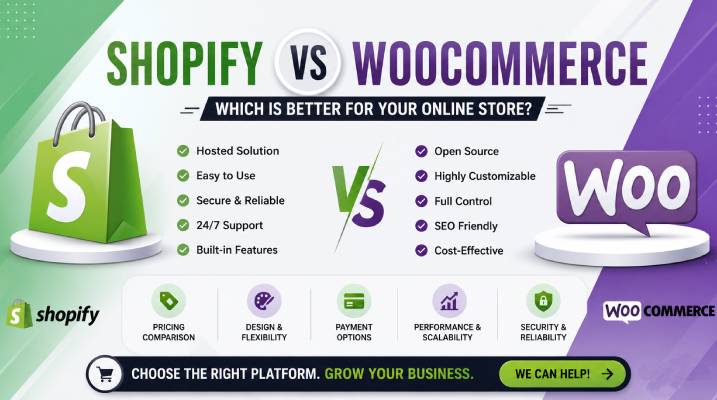
Shopify vs WooCommerce: Which Is Better for Your Online Store
Choosing the right eCommerce platform is one of the most important decisions for any online business. Two of the most popular options available today are Shopify vs WooCommerce. Both platforms power millions of online stores worldwide and offer powerful tools to help businesses sell products online.
However, each platform has its own strengths, limitations, and ideal use cases. In this guide, we’ll compare Shopify vs WooCommerce across key areas including ease of use, pricing, design flexibility, SEO, performance, security, and scalability to help you determine which platform is best for your business.
Shopify vs WooCommerce
Overview of Shopify
Shopify is a fully hosted eCommerce platform that allows businesses to create and manage online stores without worrying about hosting, security, or technical maintenance.
With Shopify, everything is included in one platform, including hosting, SSL certificates, security updates, and payment processing.
Key Benefits of Shopify
- Easy setup and management
- Secure and reliable hosting
- Professional themes
- Built-in payment processing
- Excellent customer support
- Large app marketplace
Shopify is ideal for business owners who want a simple and hassle-free solution for launching and managing an online store.
Overview of WooCommerce
WooCommerce is an open-source eCommerce plugin built for WordPress. It transforms a standard WordPress website into a fully functional online store.
Unlike Shopify, WooCommerce gives users complete control over every aspect of their website, including design, functionality, hosting, and integrations.
Key Benefits of WooCommerce
- Full ownership and control
- Unlimited customization options
- No platform restrictions
- Extensive plugin ecosystem
- Strong SEO capabilities
- Flexible pricing
WooCommerce is ideal for businesses that want maximum flexibility and customization.
Ease of Use
Shopify
Shopify is designed specifically for eCommerce and offers one of the easiest store setup experiences available.
Users can:
- Create products quickly
- Manage inventory
- Process orders
- Accept payments
- Customize store appearance
All through a simple and user-friendly dashboard.
WooCommerce
WooCommerce offers greater flexibility but requires more technical setup.
Store owners must manage:
- Hosting
- WordPress installation
- Plugin updates
- Security
- Backups
While WooCommerce is relatively easy to use, it generally has a steeper learning curve than Shopify.
Winner: Shopify
For beginners and non-technical users, Shopify provides a simpler and more streamlined experience.
Pricing Comparison
Shopify Pricing
Shopify operates on a subscription model with monthly fees.
Costs typically include:
- Shopify plan subscription
- Premium themes (optional)
- Apps and extensions
- Transaction fees (depending on payment gateway)
The advantage is predictable monthly pricing.
WooCommerce Pricing
WooCommerce itself is free, but additional costs may include:
- Web hosting
- Domain registration
- Premium themes
- Paid plugins
- Maintenance services
The total cost depends on the complexity of your store.
Winner: Depends on Your Needs
- Small stores often find Shopify easier to budget.
- Larger businesses may find WooCommerce more cost-effective over time.
Design Flexibility
Shopify
Shopify provides professionally designed themes that are easy to customize.
However, customization options may be limited compared to WooCommerce unless custom development is performed.
WooCommerce
WooCommerce offers virtually unlimited design possibilities.
Businesses can:
- Use thousands of WordPress themes
- Create custom layouts
- Modify functionality extensively
- Integrate unique features
Winner: WooCommerce
For businesses requiring unique designs and advanced customization, WooCommerce offers greater flexibility.
Payment Gateways
Shopify
Shopify supports:
- Shopify Payments
- PayPal
- Stripe
- Razorpay
- Authorize.net
- Numerous other gateways
Payment integration is straightforward and secure.
WooCommerce
WooCommerce supports nearly every payment gateway available through plugins.
Store owners have complete freedom to choose their preferred payment provider.
Winner: Tie
Both platforms offer excellent payment gateway support.
SEO Capabilities
Search engine optimization is crucial for driving organic traffic and increasing sales.
Shopify SEO
Shopify provides:
- SEO-friendly URLs
- Meta title and description management
- Mobile optimization
- Fast loading speeds
However, certain URL structures have limited customization.
WooCommerce SEO
WooCommerce benefits from WordPress‘s powerful SEO ecosystem.
With plugins such as Rank Math and Yoast SEO, businesses can:
- Customize URLs
- Optimize content
- Implement schema markup
- Manage advanced SEO settings
Winner: WooCommerce
WooCommerce provides greater control and flexibility for advanced SEO strategies.
Performance and Security
Shopify
Shopify handles:
- Hosting
- Security patches
- SSL certificates
- Server maintenance
This significantly reduces technical responsibilities.
WooCommerce
Performance and security depend largely on:
- Hosting provider
- Website optimization
- Security practices
- Plugin quality
With proper setup, WooCommerce can perform exceptionally well.
Winner: Shopify
Shopify provides a more secure and maintenance-free experience out of the box.
Scalability
Shopify
Shopify is designed to scale with business growth.
Whether you’re processing 100 orders or 100,000 orders, Shopify’s infrastructure can handle increasing demand.
WooCommerce
WooCommerce is highly scalable but requires:
- Quality hosting
- Optimization
- Technical management
Many large online stores successfully operate on WooCommerce.
Winner: Tie
Both platforms can scale effectively when implemented correctly.
Which Platform Is Best for Small Businesses?
For most small businesses, Shopify is often the easiest option.
Choose Shopify If:
- You want a quick launch
- You have limited technical knowledge
- You prefer all-in-one management
- You want minimal maintenance
Choose WooCommerce If:
- You already use WordPress
- You need advanced customization
- You want complete ownership of your website
- You have access to development support
Which Platform Is Best for Growing Brands?
Growing brands often require advanced functionality, integrations, and flexibility.
Shopify Is Best For:
- Fast-growing DTC brands
- Businesses focused on sales and operations
- Companies wanting simplified management
WooCommerce Is Best For:
- Content-driven businesses
- Brands requiring custom functionality
- Businesses seeking long-term flexibility
- Companies with unique operational requirements
Final Recommendation
Both Shopify and WooCommerce are excellent eCommerce platforms, but the best choice depends on your business goals.
Choose Shopify If:
- You want a simple, fully managed solution.
- You prefer predictable monthly costs.
- You want minimal technical involvement.
- You need to launch quickly.
Choose WooCommerce If:
- You want full control over your store.
- SEO is a major priority.
- You require advanced customization.
- You already have a WordPress website.
Ultimately, Shopify excels in simplicity and convenience, while WooCommerce offers unmatched flexibility and control.
Not Sure Which Platform Fits Your Business?
Every business has unique requirements, and choosing the right platform can significantly impact your growth and profitability.
Our team specializes in both Shopify and WooCommerce development. We can help you evaluate your goals, budget, and technical requirements to determine the best eCommerce solution for your business.
Contact us today for a free consultation and expert guidance on your next online store project.